
Big babies, Braxton Hicks, and Tdap
“Your baby might be big.” Few ultrasound comments spark more follow-up questions, and pressure for a planned induction can follow quickly. But is it actually based in evidence that if you have a big baby, you definitely need to plan for induction?
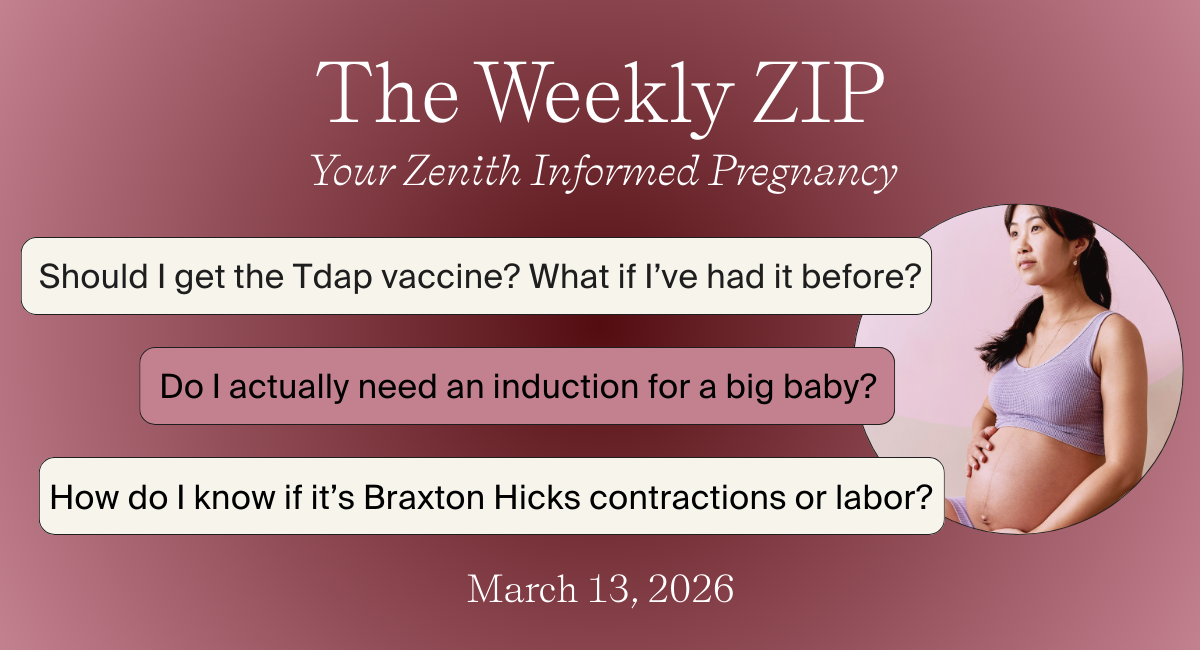
Welcome to the weekly ZIP - your Zenith Informed Pregnancy!
Read on for a quick zip through 3 of the week’s most popular pregnancy questions, and the evidence behind them. Plus - bonus content on the latest & greatest in the world of pregnancy research.
This week's top pregnancy questions:
1️⃣ How do I know if it’s Braxton Hicks contractions or real labor?
2️⃣ Do I actually need an induction for a big baby?
3️⃣ Should I get the Tdap vaccine during pregnancy? What if I already did it during a recent pregnancy?
How do I know if it’s Braxton Hicks contractions or real labor?
Feeling contractions doesn’t always mean you’re actually in labor – so what happens if you suspect “practice” contractions or “false labor?” Many first-time-moms lament the vague and unhelpful advice that “you’ll just know the difference when you feel it,” so we’re breaking down when and why Braxton Hicks contractions can occur, and what the difference is from “real” contractions signaling the beginning of labor.
📚The tl;dr from the evidence: While sometimes confusing, Braxton Hicks contractions are very common - they’re estimated to occur in 90%+ of pregnancies, even though not all women feel them. They are “practice” or “false” contractions – they do not open the cervix, whereas true labor contractions do. One way that your OB can help you be sure whether or not you’re experiencing “real” contractions is by checking your cervix.
The primary difference in how they feel are in persistence and timing - Braxton Hicks are usually irregular, unpredictable, and don’t usually get steadily stronger or closer together - in contrast to labor contractions, which come in a fairly regular pattern - getting closer together and stronger as time progresses.
Certain triggers often bring on Braxton Hicks contractions - activity/exertion, dehydration, having a full bladder/general pelvic pressure, or sex/orgasm. This means that Braxton Hicks often ease up or stop (with targeted relief measures like rest, a change in position, or hydration) while labor contractions continue regardless of what you do.
👀 Read Penny’s full summary of the evidence for more on Braxton Hicks contractions
Do I actually need an induction for a big baby?
“Your baby might be big.” Few ultrasound comments spark more follow-up questions, and pressure for a planned induction can follow quickly. But is it actually based in evidence that if you have a big baby, you definitely need to plan for induction?
📚The tl;dr from the evidence: A suspected “big baby” (aka macrosomia - where your baby is expected to be large for gestational age, LGA) isn’t by itself a standalone reason to induce early, prior to 39 weeks, but there are many additional factors and tradeoffs that go into planning for the safest and healthiest birth. Right now, the evidence isn’t strong/definitive enough on the benefit of early delivery, as compared to the potential risks/downsides, to be uniformly recommended for all cases of LGA babies – especially those without other pregnancy risk factors.
What does the data show on outcomes? Induction may lower the risk of shoulder dystocia (a delivery complication where the baby’s shoulder gets stuck during birth, more prevalent with larger babies), but earlier delivery may also increase “early term” newborn complications. Having both a big baby estimate with other factors is what drives a stronger medical reason for induction - so typically this would entail maternal conditions, like diabetes or hypertension/preeclampsia, or going past term.
One big question mark in the equation is the likelihood that your baby is actually big. Ultrasound size estimates aren't very precise, and the accuracy can even decrease at higher weights. This uncertainty, combined with the mixed results on proof of benefit, means that you should weigh your specific situation carefully with your doctor and understand which approach is most likely to be beneficial for you - rather than any blanket recommendation to “definitely induce” or “definitely wait.”
👀 Read Penny’s full summary of the evidence for more on big babies & induction
Should I get the Tdap vaccine during pregnancy? What if I already did it during a recent pregnancy?
The Tdap vaccine is routinely recommended during pregnancy, but it can raise questions, especially with ongoing media headlines about vaccines or for moms who’ve received it recently during a prior pregnancy. Here’s what the data tells us about its safety and efficacy in preventing pertussis.
📚The tl;dr from the evidence: The Tdap vaccine is a combination vaccine protecting against tetanus, diphtheria, and pertussis. It’s very widely recommended during pregnancy, as it’s one of the most effective ways to protect your baby from whooping cough (aka pertussis) in the first few months of life – receiving the vaccine during pregnancy helps your body make important antibodies that pass on to your baby before birth. Pertussis can be a very serious infection for young infants, but is largely preventable with maternal vaccination.
It’s a proven and safe approach to substantially lower the risk of your baby getting sick before they’re able to receive vaccinations of their own to protect them – data has shown a ~78% lower risk of pertussis in babies less than 2 months old when the mother is given Tdap in the recommended window of 27-36 weeks of pregnancy. The safety data is strong - ongoing monitoring and existing large studies have not found higher rates of adverse maternal or newborn outcomes when the vaccine is given during pregnancy.
Even if you’ve gotten Tdap in prior pregnancies, it is beneficial to get it again in subsequent pregnancies – the antibodies that are passed to and protect your baby drop pretty quickly after vaccination (within 2-3 years). For the strongest and most effective protection for your subsequent baby, getting another dose during your current pregnancy is recommended.
👀 Read Penny’s full summary of the evidence for more on the Tdap vaccine
🤓 Zenith's top read of the week
Bonus: what the Zenith team found interesting this week. Think cool pregnancy research or recently published studies, news in pregnancy health and policy, and more!
It's a dangerous complication of pregnancy — but a new drug holds promise (Ari Daniel, NPR) - Preeclampsia is both common (up to ~8% of pregnant mothers) and dangerous - it’s a pregnancy complication that can manifest as increased blood pressure, increased stress on organs, increased risk of seizures, and in severe cases, can even be life threatening. Despite the severity and prevalence, we still don’t fully understand why it happens, nor do we have a real treatment other than managing blood pressure for as long as possible, and likely delivering the baby as early as is safe.
That's why the potential for a new drug that can actually treat the causes of preeclampsia is so exciting. This NPR piece details a trial that is happening in a South African hospital with a new drug candidate – that was originally investigated for stroke, but shows the potential to be very meaningful in preeclampsia care. There’s still testing and trials to be completed before the drug could be approved for preeclampsia and used broadly, but hooray for innovation in this critical area of maternal healthcare!
Key excerpt:
When the 16th patient received the next highest dose, however, "we literally just opened up this IV infusion and then her blood pressure stabilized," recalls Cluver. "We suddenly saw these sky-high blood pressures coming down and we were like, 'We don't believe this. This is impossible!'" …
"But what is really promising about this particular study is that it also increases placental blood flow," she adds. That is, this new drug lowers the mother's blood pressure while also improving blood flow to the womb at a time when the baby appears to need it.


