
Hep B, Robitussin, and third trimester movement
Last Friday, the CDC’s ACIP announced the removal of the universal recommendation for receiving the hepatitis B vaccine at birth. This change to three-decade-old guidance has caused many expecting moms to wonder what changed, and what is the best plan for their baby.
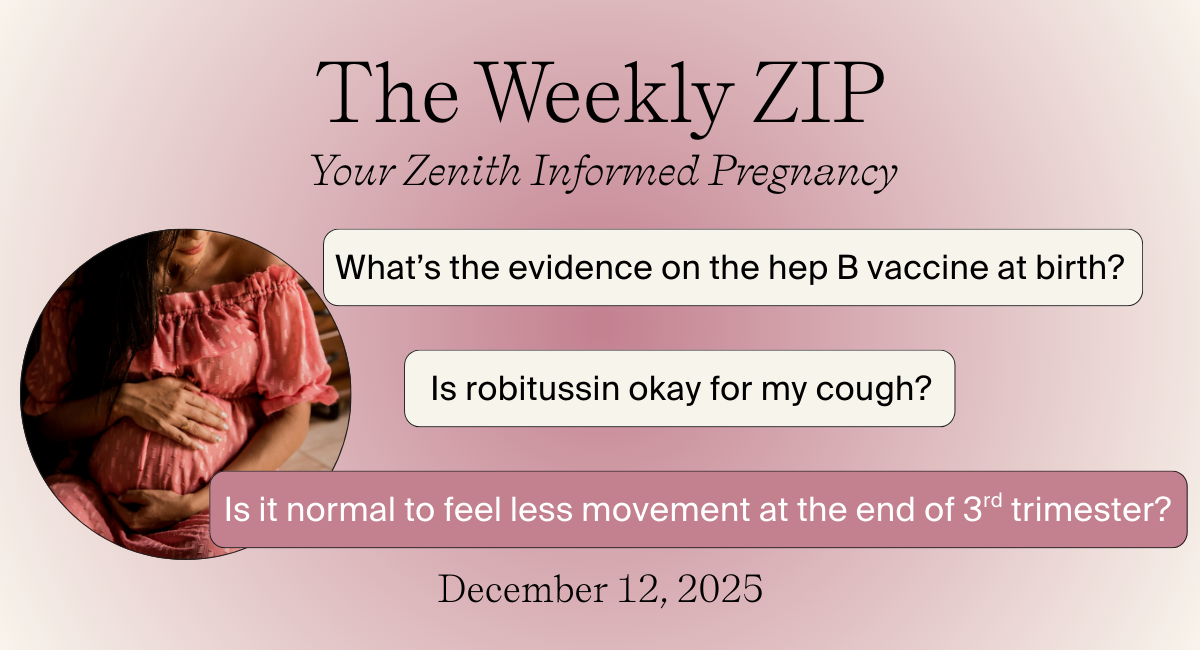
Welcome to the weekly ZIP - your Zenith Informed Pregnancy!
Read on for a quick zip through 3 of the week’s most popular pregnancy questions, and the evidence behind them. Plus - bonus content on the latest & greatest in the world of pregnancy research.
This week's top pregnancy questions:
1️⃣ Is Robitussin safe for my cough while I'm pregnant?
2️⃣ What is the evidence behind the changing recommendation on the hepatitis B vaccine for newborns?
3️⃣ Is it normal to feel less or no movement at the end of the third trimester?
Is Robitussin safe for my cough while I'm pregnant?
It seems like just about everyone is sick right now, regardless of where you are in the country - it’s that time of year for colds, coughs and viruses making the rounds. The safety of Robitussin for a cough was the #1 Penny question over the last week, so here’s what’s been studied and what we know today.
📚The tl;dr from the evidence: The active ingredients in Robitussin are dextromethorphan (a cough suppressant) and guaifenesin (an expectorant, which thins and loosens mucus in the lungs). The data is not perfect and is largely built on observational studies, which may be affected by confounding factors, but Robitussin is generally considered relatively low risk, particularly after the first trimester.
In the research looking at dextromethorphan, no increase in adverse outcomes like major birth defects, miscarriage, or stillbirth has been observed in the data that we have. Guaifenesin has been studied less, and comes with some additional cautions on potential first trimester risks. Some studies have suggested a possible small increase in birth defects with first trimester guaifenesin use, especially when also in the presence of illness with fever. The data is not conclusive, but some guidelines suggest avoiding guaifenesin in the first trimester out of caution.
It’s always important to check the label of the specific product you’re using, since different versions contain different ingredients - Robitussin DM, a common formulation, contains both active ingredients, but you can also look for one of the formulations without guaifenesin. You can always talk with your provider about which medication might be best suited for your circumstances and preferences, if you’re not sure.
👀 Read Penny’s full summary of the evidence for more on robitussin and cough remedies
What is the evidence behind the changing recommendation on the hepatitis B vaccine for newborns?
Last Friday, the CDC’s Advisory Committee on Immunization Practices (ACIP) announced the removal of the universal recommendation for newborns to receive the hepatitis B vaccine at birth. This change to the prior policy has caused some confusion and led many expecting moms to wonder what is best for their baby, and how to include vaccination preferences/schedules in their birth plan. We’re breaking down what's behind the change, and what the data shows about the vaccine.
📚The tl;dr from the evidence: The recommendation change was not based in new data emerging around the safety or efficacy of the vaccine. Robust evidence has demonstrated safety, and data has shown the vaccine has reduced childhood hep B rates significantly (by 99% since the universal recommendation was put in place in 1991).
The new guidance focuses on individualized plans rather than a blanket guidance for all newborns. Only babies born to mothers who are hepatitis B-positive are now recommended to get the vaccine at birth, and others are to generally wait until 2 months of age or consult with a provider to choose when the first dose is given.
While data supports that if mom tested negative for hep B, no one in the household has it, and the baby won’t be exposed to infected fluids, the risk of infection before 2 months of age for that specific baby is very low – this relies on both accurate testing and avoiding unexpected exposures. This can be meaningful as ~30% of new hep B infections have no identified source, and introducing tiers of who "needs" it most can inevitably lead to some babies slipping through the cracks, leading to higher rates overall in the population and more (preventable) outcomes of lifelong infections and the resulting health complications.
The change in guidelines is not expected to change insurance coverage, accessibility or availability of the vaccine at birth for those who want their babies to receive it, and major clinical organizations like the American Academy of Pediatrics have put out statements strongly encouraging that all newborns still receive the first dose within 24 hours of birth.
👀 Read Penny’s full summary of the evidence for more on the evidence behind the hep B vaccine for newborns
Is it normal to feel less or no movement at the end of the third trimester?
Feeling your baby move can be a different experience for everyone, and lead to lots of (often fun!) speculation about what causes baby to move more, when baby is most active, and what it actually feels like. From the availability of at-home fetal doppler devices, and popular online/social media suggestions about the baby growing and 'running out of room to move' towards the end of pregnancy, what does the data show about what’s normal vs what is cause for assessment by a doctor?
📚The tl;dr from the evidence: Movement patterns may shift throughout and towards the end of pregnancy, but a significant decrease in movement or not feeling movement at all is not considered normal in the third trimester. Movement may come in different forms, like more of a rolling or stretching motion rather than distinct ‘kicks’, but consistent frequency is what’s most important. If you experience a persistent decrease in frequency or no movement (~10 movements over the course of 2 hours is a standard check), you should reach out to your doctor promptly to get checked as it may be a sign of fetal distress.
How to manage tracking when it feels overwhelming? Programs like Count the Kicks provide free resources and educational materials to support moms in tracking the baby’s movement and identifying any abnormalities, as ‘normal’ movement patterns can be specific to your body and baby.
While it may seem helpful as a self-serve, higher-tech way to monitor the baby, devices like the at home fetal doppler are often cautioned against by providers and public health organizations. Without the proper training, it’s easy to incorrectly interpret the readings. This can both cause anxiety where unwarranted (in the case of inability to find a heartbeat, due to user error) or delay getting necessary medical checks and care, increasing the risks of severe and devastating outcomes like stillbirth (if a reading is misinterpreted and creates a false sense of reassurance).
👀 Read Penny’s full summary of the evidence for more on movement changes in the third trimester
🤓 Zenith's top read of the week
Bonus: what the Zenith team found interesting this week. Think cool pregnancy research or recently published studies, news in pregnancy health and policy, and more!
Health Issues in Middle Age Can Be Linked to Pregnancy Years Earlier (Danielle Friedman, The New York Times) - Pregnancy is a window into the future health of moms, and this piece in the New York Times gave great coverage on this. The article details how the medical system often treats pregnancy like a '9-month blip' – even though complications that happen during pregnancy can predict serious longer-term or later-in-life risks like heart disease, stroke, or diabetes.
More research is needed to understand whether pregnancy complications cause these issues later in life, if they simply reveal a predisposition to them earlier than we'd otherwise see, or a combination of both – but it’s encouraging to see mainstream coverage and awareness in the meantime, so that practical steps in preventative care and screenings can become more widespread without delay.
Key excerpt:
“...even with growing evidence of a link between pregnancy and heart disease, standard medical intake forms do not typically ask women about pregnancy complications, and patients’ pregnancy records do not typically follow them throughout the medical system, so their pregnancy history is often overlooked. “We don’t really have a seamless transition from obstetric to internal medicine care for these cases,” Dr. Garovic said.
… And so, many women remain in the dark about the risks. A recent study conducted by Dr. Yu found that less than half of women who experienced a cardiovascular or metabolic complication during pregnancy received basic follow-up screening for blood pressure, cholesterol or blood sugar in the three years after pregnancy.”


