
Laughing gas, antidepressants and sunless tanning
Epidurals tend to get the most attention as moms prepare for labor pain relief, but they’re not the only option. Nitrous oxide, or “laughing gas,” is another pain management option that comes with its own pros and cons – so here’s what you can consider if you’re interested in trying it.
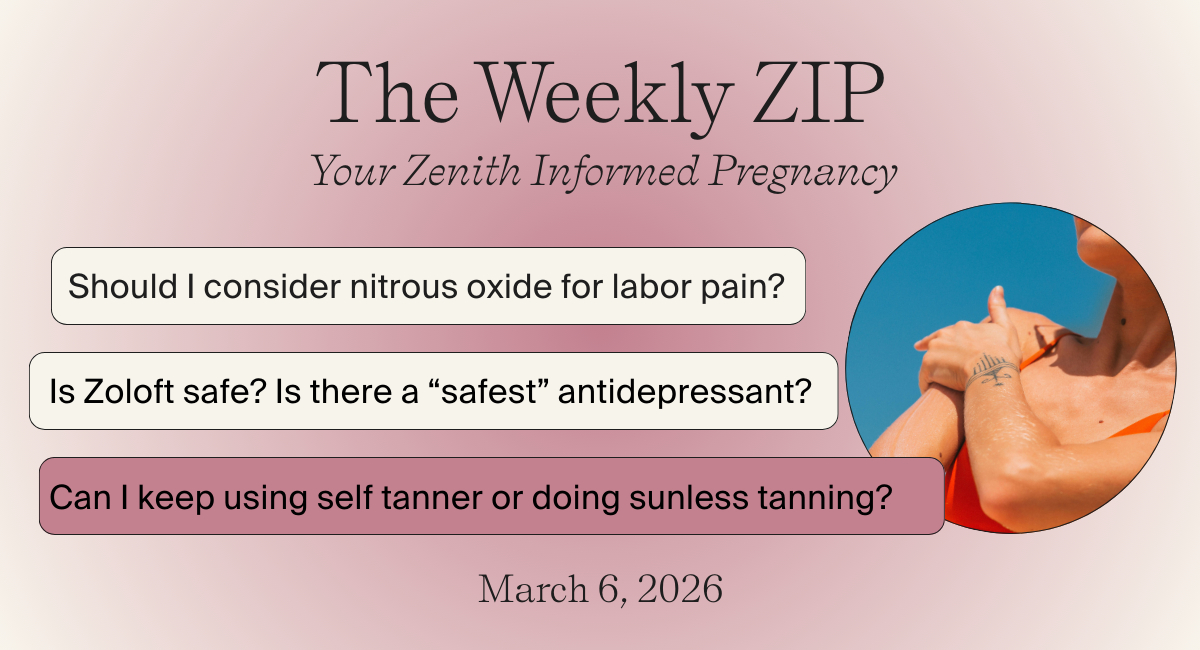
Welcome to the weekly ZIP - your Zenith Informed Pregnancy!
Read on for a quick zip through 3 of the week’s most popular pregnancy questions, and the evidence behind them. Plus - bonus content on the latest & greatest in the world of pregnancy research.
This week's top pregnancy questions:
1️⃣ Can I use self tanner or do sunless tanning while pregnant?
2️⃣ Should I consider nitrous oxide for labor pain management, instead of an epidural?
3️⃣ Is Zoloft safe? Is there a “safest” antidepressant during pregnancy?
Can I use self tanner or do sunless tanning while pregnant?
Spring, summer, and sunny vacations are finally just around the corner! Many skincare and cosmetic products are reconsidered during pregnancy, and there’s been a rise in questions about safety considerations for self tanners and spray tans. Here’s what the data shows about the various forms of sunless tanning during pregnancy.
📚The tl;dr from the evidence: There is not any compelling evidence that self tanners used at home (creams, lotions, mousses, etc) cause harm during pregnancy - DHA, the primary active ingredient, stays on the surface of your skin and very little is expected to make it into your bloodstream.
Additional caution is sometimes recommended with spray tans, where the mist could be inhaled or get into your eyes/lips – although this caution stems more from a lack of any direct research, rather than known harms or concerns. In general (not pregnancy specific!), DHA is not approved to be inhaled or used on the mucous membranes (inside of your nose, eyes, lips, etc) - so this is why spray tans are often treated differently from creams that you rub into your skin directly.
Tanning beds raise different concerns - UV radiation and heat/overheating. There aren’t any studies that clearly measure pregnancy outcomes after UV tanning bed use, but there are known pregnancy risks with UV exposure and prolonged rising of core body temperature, as well as general (non-pregnancy) concerns associated with tanning beds like increased skin cancer risk. UV exposure has been observed to break down folate in some cases, and folate is very important in early pregnancy – shown with strong evidence to reduce the likelihood of neural tube defects in the baby.
With what we know from the data, self-tanning creams are likely amongst the safest options - even including “natural” tanning outdoors, which carries the risks of UV exposure/potential sunburn.
👀 Read Penny’s full summary of the evidence for more on sunless tanning
Should I consider nitrous oxide for labor pain management, instead of an epidural?
Epidurals tend to get the most attention as moms prepare for labor pain relief, but they’re not the only option. Nitrous oxide, also known as “laughing gas,” is another pain management option that comes with its own pros and cons – so here’s what you can consider when deciding if it’s an option you’re interested in trying.
📚The tl;dr from the evidence: Nitrous oxide is a form of pain management that you breathe in through a mask during contractions, and is shown to be both safe and effective in short-term use during labor. There are pros and cons, especially when considering other medication pain management options (like an epidural) against your birth preferences.
One of the biggest reasons people choose it is control - it’s self-directed, meaning you can start or stop at any time, and wears off quickly after you stop inhaling - so it often means you can maintain mobility for longer when compared to other options like epidural. Some practical tips - since it takes ~30-60 seconds to reach its strongest effect, you’ll want to try to breathe it in before the contraction starts or peaks. It can be used in all stages of labor, and starting earlier when you can focus on technique can help with effectiveness later on.
The biggest “con” is that nitrous oxide usually isn’t as strong as an epidural in terms of pain relief. Research has shown that there’s a large share of moms who start with nitrous oxide, and ultimately switch later on in labor to an epidural or other pain management approach because they’re seeking stronger relief – some moms have described it as more like “taking the edge off” vs actually eliminating pain. Some women may also experience side effects like nausea, dizziness, or drowsiness.
👀 Read Penny’s full summary of the evidence for more on nitrous oxide
Is Zoloft safe? Is there a “safest” antidepressant during pregnancy?
SSRI (antidepressant medication) use during pregnancy is a constantly debated topic, with often-conflicting advice. Zoloft (the brand name for sertraline) is sometimes referred to as the “safest” SSRI for pregnancy - but what does that mean practically, and can evidence help settle the debates in the headlines and conflicting takes?
📚The tl;dr from the evidence: While we don’t have ideal evidence on SSRIs (coming from a randomized controlled trial), sertraline is both more commonly used during pregnancy than other SSRIs, and has shown a lower risk signal for a potential newborn complication called PPHN (persistent pulmonary hypertension of the newborn). In breastfeeding, infant blood levels of sertraline are generally very low or undetectable - making it a good choice for those who are prioritizing breastfeeding. Overall, while not perfect, the data suggests limited risks.
For these reasons, sertraline is often considered a “preferred” SSRI during pregnancy, all else equal - but the choice of staying on, starting, or discontinuing any SSRI during pregnancy is personal, and should be made with your care team with consideration for your overall medical history and current situation.
Does this mean you should switch if you’re on a different SSRI? Most guidelines advise that if your existing medication is working well for you, continuing through pregnancy is a reasonable choice – as stopping or switching can actually introduce new risks. Relapse is shown to be more common when stopping or switching, and unmanaged depression comes with its own non-trivial set of risks to consider.
If you are thinking about trying to conceive and considering switching to sertraline, it’s recommended to do it early (before pregnancy, ideally a minimum of 2-3 months before conceiving) – not stopping or switching “cold turkey”. This provides enough time to taper your existing medication and monitor how you respond to the new medication. There are mental health providers who specialize in reproductive psychiatry, so it can be especially beneficial to work with someone like this who is experienced with the perinatal period.
👀 Read Penny’s full summary of the evidence for more on zoloft and SSRI safety
🤓 Zenith's top read of the week
Bonus: what the Zenith team found interesting this week. Think cool pregnancy research or recently published studies, news in pregnancy health and policy, and more!
The effects of a second pregnancy on women’s brain structure and function (Milou Straathof et al, Nature) - This new paper, recently published in the top-tier scientific journal Nature, set out to build on our knowledge of what happens to a woman’s brain during pregnancy (yes, there is evidence that pregnancy brain is real!). Researchers ran a prospective study, enrolling women prior to the conception of their second pregnancy, and looked at multimodal MRI data from before/after pregnancy to see how brain changes are different in a second pregnancy.
In short, they found that the brain changes appeared as more of a “fine tuning” of the changes from a first pregnancy. Bigger changes were observed in first pregnancies, but the changes from second pregnancies affected the same parts of the brain - especially networks tied to social/emotional processing (bonding with your baby!) and attention/physical responsiveness to the outside world (translation: more adaptations for multitasking, juggling attention, and reacting quickly – all things that would make sense with a toddler at home and a new baby!)
While the study has several limitations, it’s a great step forward in continuing to understand maternal changes during pregnancy - and hopefully gives some scientific validation to second+ time moms who are noticing some of these mental changes anecdotally!
Key excerpt:
“These results show similar but less pronounced structural and functional changes in the default mode and frontoparietal network in [pregnancy 2]; stronger alterations were found in [pregnancy 2] in the dorsal attention and somatomotor network including the corticospinal tract, pointing to an enhanced plasticity within these externally-oriented networks. Neurostructural changes in both groups related to mother-infant attachment and peripartum depression. These findings show that a second pregnancy uniquely changes a woman’s brain, entailing both convergent and distinct neural transformations."


