
Microplastics, leaking, and salicylic acid
A new Netflix documentary has brough microplastics & fertility mainstream for many women – whether already exposure-conscious and wellness-optimizing, or just being introduced to this potential dimension of fertility. What studies actually exist, and do they support the link?
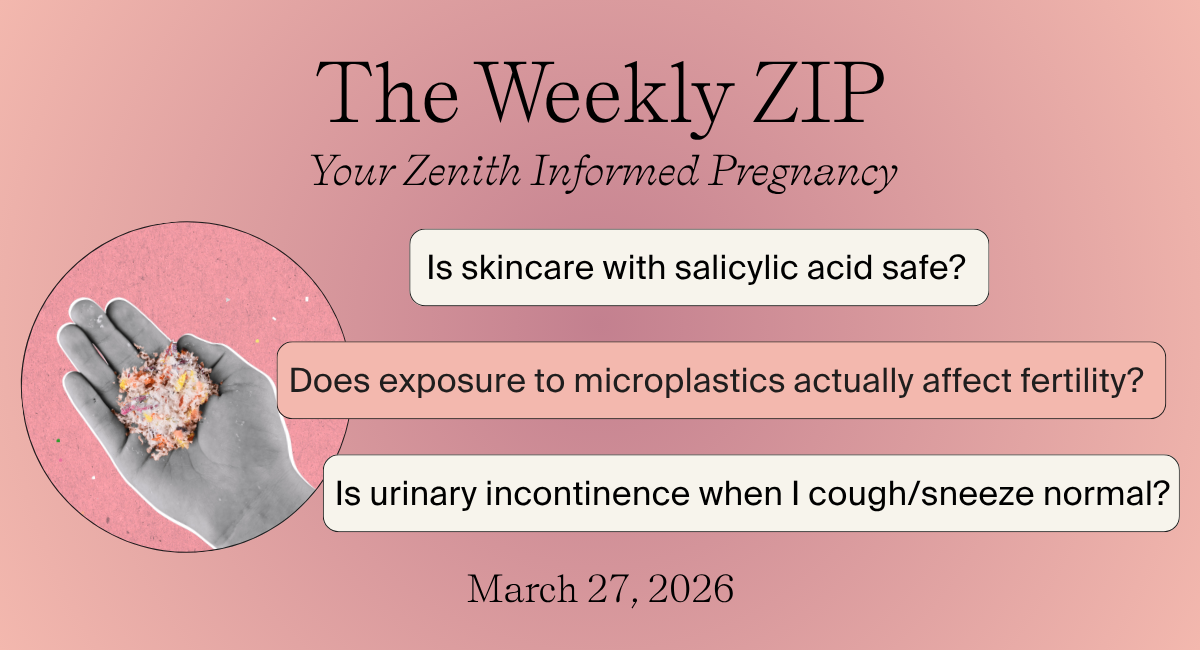
Welcome to the weekly ZIP - your Zenith Informed Pregnancy!
Read on for a quick zip through 3 of the week’s most popular pregnancy questions, and the evidence behind them. Plus - bonus content on the latest & greatest in the world of pregnancy research.
This week's top pregnancy questions:
1️⃣ Is skincare with salicylic acid safe during pregnancy?
2️⃣ Does exposure to microplastics actually affect fertility?
3️⃣ Is leaking/urinary incontinence when I cough, sneeze, laugh, etc. normal?
Is skincare with salicylic acid safe during pregnancy?
Salicylic acid is a common ingredient found in skincare routines, especially for women managing acne. With hormonal breakouts and changing skin during pregnancy, lots of questions come up about topical use of products with salicylic acid/BHAs. Here’s what the data says about its safety.
📚The tl;dr from the evidence: Topical skincare products containing salicylic acid are generally considered safe during pregnancy when used as directed in standard amounts/formulations. For treatment of acne, ACOG (the American College of Obstetricians and Gynecologists) has recommended OTC products that include salicylic acid, as well as those that contain benzoyl peroxide, azelaic acid, or glycolic acid.
Standard topical use via serums or creams results in low systemic absorption, which is why it’s not considered risky – but very high dose or procedure-like uses (e.g. chemical peels or treatments) are worth more caution/consideration. Glycolic acid or lactic acid peels (AHAs, or alpha hydroxy acids) are preferred to BHAs (beta hydroxy acids, most commonly salicylic acid peels) when used as a more concentrated treatment/peel or over very large areas like your chest, back or legs. This is because AHAs are water-soluble and exfoliate just the skin’s surface, whereas BHAs are oil-soluble and work on both the skin’s surface and in the pores. In more concentrated/higher exposure instances like a peel, BHA absorption can be much higher than in the standard topical use in a face cream, leading to increased caution.
👀 Read Penny’s full summary of the evidence for more on salicylic acid
Does exposure to microplastics actually affect fertility?
A new Netflix documentary, The Plastic Detox, has brought this question mainstream for many – whether already exposure-conscious and wellness-optimizing, or just learning about microplastics as a dimension that might actually be relevant to conceiving and carrying a pregnancy. It’s a hot topic bringing up many impassioned perspectives - but what does today’s best evidence say on how real the impact is on pregnancy health?
📚The tl;dr from the evidence: This is a newer area of scientific inquiry, without a robust base of research giving clear answers – especially in humans. Data we do have from animal studies suggests that microplastics may affect hormone production and may disrupt the development of eggs and sperm – and microplastics have been detected in reproductive-related samples/tissues (e.g. placenta, ovarian follicular fluid, and sperm – yes, male fertility is important here too!).
The presence of microplastics reaching these tissues/samples means it’s biologically plausible that fertility could be disrupted, via hormone disruption, inflammation, and/or oxidative stress (cell stress that can affect eggs/sperm and reproductive organs). However, a key limitation of extrapolating data from animal studies is that animal doses, particle types, and exposure routes may not match real-world human exposure.
It’s also worth noting that not all “microplastics” are equal, and in reproductive health research the more critical types are endocrine disrupting chemicals, or EDCs (chemicals that can interfere with hormones). Two of the more important sub-groups are bisphenols (like BPA and some substitutes) and phthalates (often used to soften plastics). Exposure type also matters - “stress” on plastics (think heat, UV/sun exposure, repeated use, contact with liquids/foods) can increase the release of additives or other chemicals.
More observational human studies are underway, but in the meantime - if you’re trying to conceive, the best guidance today is to put most of your energy into fertility factors that already have clear testing and treatment pathways – and if it feels empowering (and not stressful), you can consider low-effort exposure reductions as a general environmental health choice. Right now, the data supports reducing exposures as less about “fixing” fertility and more about making a reasonable, low-burden change in a space where the science is still catching up.
👀 Read Penny’s full summary of the evidence for more on microplastics & fertility
Is leaking/urinary incontinence when I cough, sneeze, laugh, etc. normal?
Urinary leakage is a pretty common experience in pregnancy, but it’s not talked about as much as other common symptoms: leading to many questions for moms about what’s normal, if it will last forever, and what you can do about it. Good news? There are evidence-backed approaches that can help, and explain why this frustrating symptom happens in the first place.
📚The tl;dr from the evidence: Leaking urine when coughing/sneezing/laughing (or any other activities putting pressure on your bladder) is called stress urinary incontinence, and is very common during pregnancy due to the added pressure on your bladder and pelvic floor muscles. This added pressure can reduce how strongly the pelvic floor and urethra can “hold shut” during a sudden movement like a sneeze or a laugh.
Up to 1 in 2 women experience some amount of urinary leakage during pregnancy, which tends to increase as pregnancy progresses and is most commonly experienced in the third trimester (as the baby grows and pressure on the bladder increases), and many women do continue to experience it after birth. For most, bladder control improves and returns to normal in the weeks or first months following birth.
If you don’t want to wait and hope you’ll “return to normal,” or your symptoms are more severe, there are pelvic floor muscle exercises that can help you – during and after pregnancy. Evidence (including a randomized trial!)l shows that consistent structured pelvic floor muscle training started early, during pregnancy can both help your symptoms resolve more quickly, reduce severity of symptoms, and even reduce the risk of longer term issues. Working with the support of a specialized pelvic floor physical therapist is highly recommended to ensure you’re doing the exercises correctly and are being treated appropriately for your symptoms - so if you’re experiencing stress incontinence (or just want to get ahead of it!), ask your doctor about a referral to a pelvic floor physical therapist.
👀 Read Penny’s full summary of the evidence for more on leaking and incontinence
🤓 Zenith's top read of the week
Bonus: what the Zenith team found interesting this week. Think cool pregnancy research or recently published studies, news in pregnancy health and policy, and more!
Changes in paracetamol and leucovorin use after a White House briefing (Jeremy Faust and Michael L Barnett, The Lancet) - A new research letter published in The Lancet looked at the impact of the September warnings issued by the White House regarding Tylenol during pregnancy and autism in children. While the best available evidence does not support any causal relationship between Tylenol (acetaminophen) use during pregnancy and autism, this letter shows the weight that statements like this can have on prescribing patterns.
They only look at data from hospitals, where acetaminophen would be a documented prescription from a physician (as compared to at home/over the counter use, as self-directed by women) – and saw that prescriptions to pregnant women dropped by ~10% in the weeks following the White House briefing. No statistically significant change was observed in prescriptions for non-pregnant women in the same age group.
This letter supports the disappointing conclusion that even when changes in prescribing recommendations are not based in the best available evidence and don’t go through the rigorous FDA processes, prescribing patterns can still be impacted. And if in-hospital prescriptions are impacted, it’s easy to imagine the even greater impact that misinformation can have on everyday moms at home, trying to figure out what to do to treat fever or pain effectively.
Key excerpt:
“Although causal claims cannot be made, the observed associations are consistent with influence of new FDA recommendations on clinical decisions. It is unknown whether the results reported reflect changes in patient demand or clinician decision making; nonetheless, they show the apparent power that public authority figures have to drive sudden changes in health-care practices.”


