
Nosebleeds, red raspberry leaf, and anatomy scans
Like eating dates, drinking red raspberry leaf tea is one of the most popular suggestions in preparing for labor. There’s a wide range of beliefs on its benefit - speeding up labor, reducing interventions, or even inducing labor. So which of these benefits does the evidence actually support?
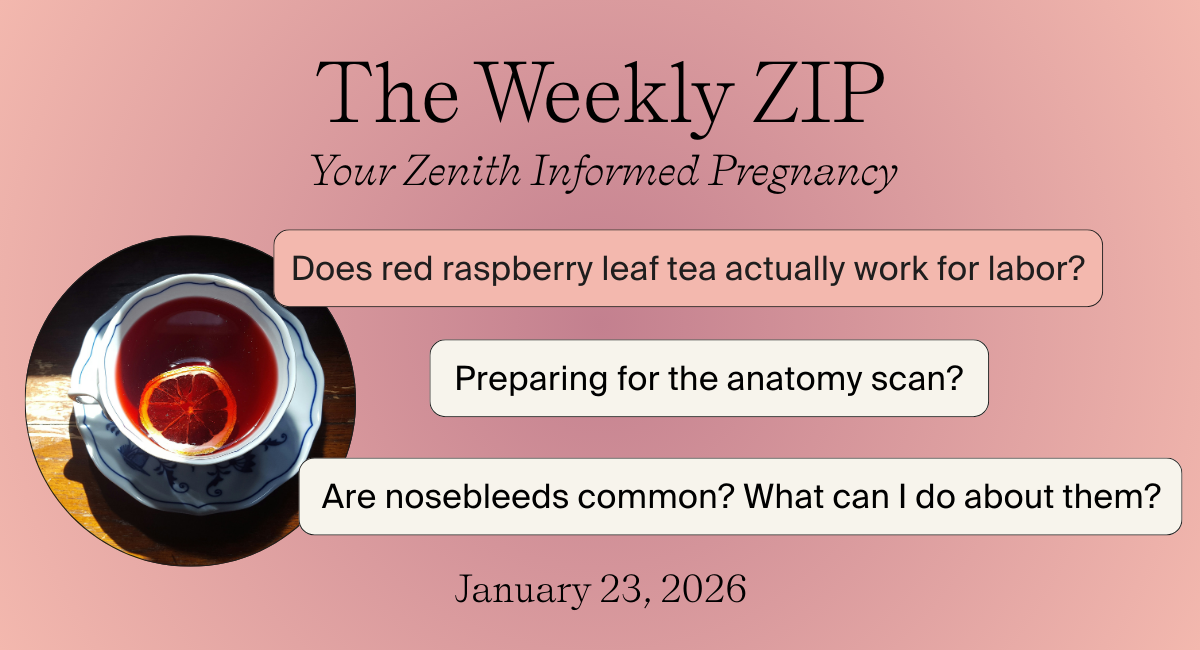
Welcome to the weekly ZIP - your Zenith Informed Pregnancy!
Read on for a quick zip through 3 of the week’s most popular pregnancy questions, and the evidence behind them. Plus - bonus content on the latest & greatest in the world of pregnancy research.
♥️ It's Maternal Health Awareness Day (Jan 23), and we at Zenith are proud to be working in service of maternal health today and every day. Uplifting evidence-based approaches to care and increasing access to information improves outcomes for moms - today is a reminder that we can all play a part in better maternal health outcomes!
This week's top pregnancy questions:
1️⃣ Are nosebleeds common in pregnancy, and what can I do?
2️⃣ Does red raspberry leaf tea actually work for labor?
3️⃣ Preparing for the anatomy scan and what to expect?
Are nosebleeds common in pregnancy, and what can I do about them?
Seemingly random nosebleeds can be yet another unexpected and inconvenient symptom during pregnancy. How common are they, why do they happen in pregnancy, and what can you actually do about them?
📚The tl;dr from the evidence: Around 1 in every 5 pregnant women (~20%) experience nosebleeds, compared to just ~6% of the general population – so nosebleeds are a pretty common experience for expecting moms. This increased frequency is due to two pregnancy related factors: hormonal changes, and increased blood flow.
During pregnancy, hormones like estrogen and progesterone can actually cause the blood vessels in your nose to expand, becoming more fragile and susceptible to breaking. On top of that, your increased blood volume and blood flow can put more pressure on these already-delicate nasal blood vessels. (And yes - these same mechanisms are what lead to the sometimes baffling symptom described as “pregnancy nose,” where your nose can look slightly swollen or puffier than normal during pregnancy!)
What can you do? If it’s already happening, you can lean slightly forward and firmly pinch the soft part of your nose. To try and reduce frequency, especially in these cold winter months, you might consider using a humidifier indoors or applying a tiny, thin layer of aquaphor or vaseline just inside of your nostrils to reduce dryness.
👀 Read Penny’s full summary of the evidence for more on pregnancy nosebleeds
Does red raspberry leaf tea actually work for labor?
Like eating dates, drinking red raspberry leaf tea is one of the most popular recommendations that moms hear in preparing for labor. There’s a wide range of popular beliefs on red raspberry leaf - from speeding up labor, to reducing c-sections, or even to naturally induce labor. So which, if any, of these benefits does the evidence actually support?
📚The tl;dr from the evidence: While generally considered safe, there is not strong scientific evidence supporting its effectiveness. The mechanism by which red raspberry leaf is believed to help labor is by helping to strengthen the uterus and support more efficient uterine contractions, although studies that have looked at labor outcomes with red raspberry leaf have generally been small and their findings have been inconsistent.
There is no evidence, for example, that it can reliably induce/start labor. Some studies suggest potential benefits in labor length (e.g. a slightly shorter pushing phase of labor) or a lower chance of requiring certain interventions, but the evidence is not consistent or strong enough to say that red raspberry leaf is a reliable way to achieve these outcomes.
All that said, it’s unlikely to be harmful when used late in pregnancy - some women experience mild digestive side effects, but if you are interested in trying it, the overall risk is low. It’s just not (yet!) scientifically shown to result in many of the labor benefits many moms are seeking.
👀 Read Penny’s full summary of the evidence for more on red raspberry leaf tea
Preparing for the anatomy scan and what to expect?
The days and weeks leading up to the anatomy scan appointment often come with many questions, both practical and emotional. From the excitement about seeing a detailed view of your baby for the first time, to nerves about hoping your baby is growing normally or getting clear images, there are ways to prepare yourself for a positive and confident experience.
📚The tl;dr from the evidence: The prenatal appointment called the “anatomy scan” is an ultrasound exam typically done anywhere between 18 and 22 weeks of pregnancy, and aims to provide a thorough check-in on your baby’s development. This includes examining your baby’s head, limbs, and organs, taking baby’s measurements, and looking at the position of the placenta as well as the amount of amniotic fluid. It’s also when you can typically determine the baby’s gender (if you want to find out!).
It can last ~30-60 minutes, and sometimes even longer depending on your baby’s position. The scan taking longer than expected, a focused and quiet sonographer, or even being asked to return for another scan or tests, does not mean that something’s wrong. There are factors outside of your/the sonographer’s control that might make it difficult to get all of the images needed in the initial scan, even if everything is normal.
With regards to any potentially abnormal findings, the anatomy scan is a powerful, but not perfect, tool in identifying any potential issues with how your baby is developing – some types of structural problems (e.g. neural tube defects, severe limb/skeletal abnormalities) are successfully detected 90%+ of the time, whereas heart or other organ defects can be a bit more challenging to detect. Factors like the baby’s position, amount of amniotic fluid, and even the experience of the sonographer can affect how well the scan detects birth defects - but no scan can guarantee that all problems will be found.
The anatomy scan offers an important snapshot into the baby’s growth. While it can’t answer every question or rule out every possible issue, it provides valuable insight into how your baby is developing and helps guide next steps if anything needs a closer look. Going in with realistic expectations, and understanding its purpose and limits, can help you feel more prepared and supported going into the appointment.
👀 Read Penny’s full summary of the evidence for more on anatomy scans
🤓 Zenith's top read of the week
Bonus: what the Zenith team found interesting this week. Think cool pregnancy research or recently published studies, news in pregnancy health and policy, and more!
Lancet study: Tylenol use during pregnancy does not cause autism (O. Rose Broderick, STAT News) - Over the past few months, the headlines have been filled with confusing and anxiety-inducing questioning of whether Tylenol is actually related to autism diagnoses or not. While professional clinical organizations like the ACOG continued to recommend the safety of Tylenol, particularly for management of otherwise serious pregnancy concerns, like fever – it’s understandable that the lack of a clear message left many women nervous.
Last week, The Lancet published a new systematic review, looking at the 43 best-designed studies that have examined the Tylenol <> neurodevelopmental disorder link, and the authors concluded the same thing that leading physicians have been repeating – Tylenol is very unlikely to cause autism, and prior studies that have shown such a link are likely not properly accounting for confounding (variables that might affect both autism risk for children and Tylenol use – like chronic pain, maternal infections, or genetics).
Great to see a rigorous review of the evidence giving moms and physicians more peace of mind that Tylenol continues to be a safe and effective option when used as directed to treat fever and pain in pregnancy!
Key excerpt:
“Authors of the new Lancet study winnowed down thousands of published papers to 43 studies based on risk for “bias,” or how thoroughly papers’ study designs and protocols accounted for confounding factors, such as genetics. The authors prioritized studies in which a mother took acetaminophen during one pregnancy, but not another. If autism or other neurodevelopmental outcomes were associated with an environmental factor such as taking Tylenol, then researchers would find that differential in the siblings’ neurodevelopmental outcomes.
But that’s not what the researchers found, especially when evaluating the data from two notable studies out of Sweden and Japan, which used this method across massive datasets. When the researchers conducted a meta-analysis of these and 15 other papers, they found no association between maternal acetaminophen use and a heightened risk of autism, ADHD, or intellectual disability.”


