
Vivid dreams, Botox, and trimester zero
If your dreams lately feel more intense, detailed, or unsettling than usual, you’re not imagining it. There’s actually some science as to why you’re not just dreaming up this surprising symptom - read on to learn why vivid dreams are such a common pregnancy experience!
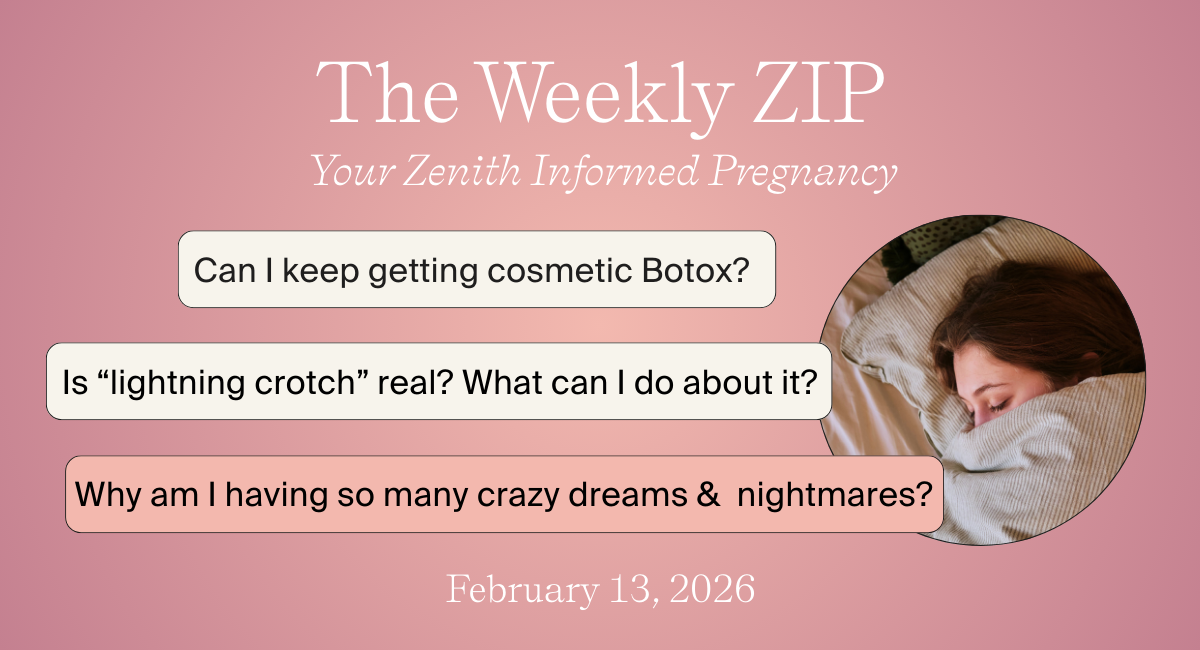
Welcome to the weekly ZIP - your Zenith Informed Pregnancy!
Read on for a quick zip through 3 of the week’s most popular pregnancy questions, and the evidence behind them. Plus - bonus content on the latest & greatest in the world of pregnancy research.
This week's top pregnancy questions:
1️⃣ Why am I having so many crazy pregnancy dreams and nightmares?
2️⃣ Is “lightning crotch” real? What can I do about it?
3️⃣ Can I keep getting cosmetic Botox during pregnancy?
Why am I having so many crazy pregnancy dreams and nightmares?
If your dreams lately feel more intense, detailed, or unsettling than usual, you’re not imagining it. There’s actually some science as to why you’re not just dreaming up this surprising symptom - read on to learn why vivid dreams are such a common pregnancy experience!
📚The tl;dr from the evidence: One somewhat unsatisfying, but real, reason for experiencing vivid pregnancy dreams is simply how much more you wake up during the night. Whether due to discomfort and changing positions more often, or getting up to pee – waking up right after a dream means you’re much more likely to remember it in detail, so it may actually be that you’re not dreaming more, just remembering or recognizing more of your dreams.
Additionally, changes in your hormones (particularly progesterone) affect both sleep patterns themselves - like your REM sleep cycles, which is the stage of sleep where dreaming is common - and how your brain actually processes emotions. This combination can contribute to why you wake up remembering dreams, and why they might feel more vivid or emotionally intense. Dreams can reflect your subconscious thoughts or worries - and pregnancy is a major emotional and physical transition, so dreams that reflect worries about your baby, birth, or parenting are common as well.
“Get more/better sleep” can sound cliche, especially during pregnancy and early parenting, but it’s true - finding small ways to improve your sleep hygiene can make a difference if frequent or recurring nightmares are plaguing you. Keeping a consistent sleep/wake schedule, committing to a relaxing wind-down routine before bed (including cutting back on screen time!), and considering shifting your water/fluid intake earlier in the day to reduce the likelihood of needing to get up to pee in the middle of the night are all science-backed strategies that can help!
👀 Read Penny’s full summary of the evidence for more on crazy vivid dreams & nightmares
Is “lightning crotch” real? What can I do about it?
The end of pregnancy often comes with a fair amount of daily discomfort, and a readiness to have the baby already! “Lightning crotch” is indeed a real pregnancy symptom, and it’s easy to wonder if what you’re experiencing is round ligament pain, braxton hicks contractions, real contractions, SPD pain, or something else altogether. Here’s how and why you might experience this symptom, and what you can do about it.
📚The tl;dr from the evidence: If you feel a very sudden “zap” or jolt-like sensation or pain in your pelvis, it’s likely the not-so-fun pregnancy symptom (aptly) called “lightning crotch.” It’s brief (happens for seconds, not hours or all day) and unpredictable in terms of when it hits, but can start happening in the third trimester and towards the end of pregnancy. It’s believed to occur due to irritation or pressure on the nerves around the cervix and pelvis as your baby grows larger, the uterus gets heavier, and/or as your baby moves lower in the pelvis as you approach labor and birth.
One of the most confusing parts can be just identifying it - given that late pregnancy comes with multiple flavors of potential pelvic discomfort or pain. Contractions are more regular and repeatable than lightning crotch (which is random, and brief), round ligament pain is a duller, aching, or pulling sensation (rather than the distinct ‘zap’ or jolting sensation), and SPD, or symphysis pubis pain, is typically more consistent and activity-related.
It’s uncomfortable, but not typically cause for concern (if you experience this type of pain constantly, for more than a minute at a time, reach out to your doctor for support and triage). Relief is focused on basic comfort measures - you can try changing positions when the pain strikes, using a belly support band to lighten the load on the pelvis, gentle movement (regular movement can actually help reduce intensity/frequency), or relaxation techniques like a warm bath or prenatal massage to release muscle tension and reduce overall discomfort.
👀 Read Penny’s full summary of the evidence for more on lightning crotch
Can I keep getting cosmetic Botox?
This might be one of the most-asked pregnancy questions out there! Cosmetic Botox has become even more popular/mainstream, and there are also women who rely on Botox for medical reasons – like managing migraines. If you haven’t been able to get a straight answer, here’s what the data tells us about Botox use during pregnancy.
📚The tl;dr from the evidence: The ever-frustrating answer: There’s not good human safety data to have strong evidence demonstrating potential harm, or demonstrating clear safety. That leaves us in the gray area where an abundance of caution is often recommended by providers. When the risk level is hard to quantify, often the decision comes down to the alternative (what would happen if you don’t take the medication/intervention)? In the case of cosmetic/elective uses, there’s no medical benefit (even though there’s often some emotional/confidence benefit!) - so most providers don’t feel comfortable justifying any potential risks without medical necessity.
Our best understanding of the science and likely biological pathways? When injected properly, Botox is expected to act locally - e.g. staying where it’s injected, so fetal risk is thought to be low as long as you don’t experience systemic side effects. Data on “accidental” exposure to Botox early in pregnancy, often before moms knew they were pregnant, has not yet shown any clear increase in birth defects or other major problems. Animal studies (although at higher doses, and sometimes different delivery mechanisms - like IV vs local injection) have shown some potential for fetal risk, although the animal studies are not conclusive nor cleanly applicable to human pregnancies.
Given what we know about how it’s likely to work in the body, continuing Botox is more commonly considered/weighed by doctors when used for a non-cosmetic medical reason (like chronic migraine or dystonia), especially when the consideration includes an alternative medication that has more of a whole-body exposure. As with any medication, you can talk directly with your OB and/or dermatologist to weigh the data against your specific situation and make a decision that is right for you.
Bonus: what about while breastfeeding? Some very small studies with standard cosmetic dosing have shown either no or very tiny amounts of Botox detected in breastmilk, and no adverse reactions in breastfed infants over the first postpartum year. Databases like LactMed consider Botox to be low risk for nursing infants with typical cosmetic dosing, although more research is needed for potentially higher doses.
👀 Read Penny’s full summary of the evidence for more on Botox
🤓 Zenith's top read of the week
Bonus: what the Zenith team found interesting this week. Think cool pregnancy research or recently published studies, news in pregnancy health and policy, and more!
The Rise of Trimester Zero (Erica Schwiegershausen, The Cut) - The concept of “Trimester Zero” and health/wellness approaches preparing women to try to conceive has been rising across social media feeds, with many-an-influencer promoting a lifestyle protocol, “simple hack,” or supplement stack with often-questionable credibility. On the flip side, many moms-to-be are eager, even desperate, for something that they can do to help feel more prepared and healthy before their first pregnancy.
This piece in The Cut raises the tension between women who are (reasonably so!) trying to feel a sense of control around something that feels otherwise overwhelming and out of their control - the ‘black box’ of fertility and conceiving a healthy pregnancy - and the unfortunate potential for even more fear mongering and manipulation, trying to sell supplements or routines that aren’t actually based in any credible science.
It’s a thought-provoking read on how we speak to and support women on the TTC & pregnancy journeys, and hope it can lead to some reflection on how providers and peers can empower women with health and wellness without over-rotating to manipulative or anxiety-based marketing tactics.
Key excerpt:
“It just feels like there’s this responsibility on mothers that starts even before you’re pregnant, like, if you don’t do all these things perfectly, then you’re being irresponsible with your future child.” Now, when [one mother] takes her 2-month-old to the pediatrician and fills out the postpartum-depression assessment, she always pauses on the question: “Have you blamed yourself unnecessarily?””


