
Why You Feel So Overwhelmed in Pregnancy
Your nervous system on pregnancy - and what actually helps
You snapped at your partner over dirty dishes. You cried at a cat food commercial. You're exhausted but can’t sleep because you’re going through the to-do lists all night. And somewhere in the back of your mind you're wondering — what is wrong with me?
Nothing is wrong with you. Your nervous system is working overtime.
Your brain is literally being rewired.
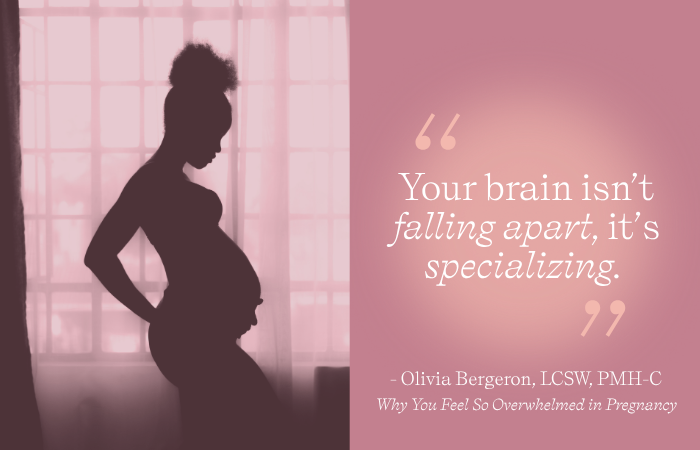
During pregnancy, it can feel like a totally different version of you has shown up. There is a very good reason for this: your brain isn't falling apart, it's specializing. You are developing the sensitivity to detect your baby's needs, which means you are now wired to feel everything more intensely. The slow cashier. Your partner's tone. The refrigerator hum at 3am. That's not necessarily anxiety. It's a more finely attuned threat-detection system.
Your stress response is doing two jobs at once.
Cortisol — your main stress hormone — rises progressively across all three trimesters. That's not a malfunction. It’s your body’s adaptation to pregnancy (Glynn & Sandman, 2011). Your body is sustaining two lives, restructuring hormonally, and preparing for one of the biggest physical events of your lifetime. Scientists call this accumulated demand "allostatic load" — and pregnancy is one of the highest allostatic load states the human body experiences (McEwen & Stellar, 1993). The exhaustion and emotional reactivity aren't weakness. They're the cost of running at full capacity.
You are a different person now.
Anthropologist Dana Raphael coined the term "matrescence" in 1973 to describe the total identity shift of becoming a mother. Dr. Alexandra Sacks brought it back into modern conversation, writing that it's "a transition as profound as adolescence." You are embarking on a developmental passage that medicine has only recently started taking seriously.
So what actually helps?
Not willpower. Not being told to relax–and really, when has that ever been helpful? According to Dr. Stephen Porges' Polyvagal Theory, your nervous system can't think its way back to calm. Instead, it needs to feel safe (Porges, 2011). And the fastest path to felt safety is connection with another regulated human being. A partner. A friend. A therapist who gets it.
Your body needs to be met — not managed.
If you're in the thick of it right now, reaching toward support isn't indulgent. It's exactly what the research says to do.
Looking for perinatal mental health support? Email Olivia@mommygroove.com or visit MommyGroove.com for ways to feel calm, confident and connected.
And for all those pesky pregnancy questions - Penny is here for you with unbiased, research-backed information at any time of the day or night.


